What to Expect-
Two Tracks, One Program
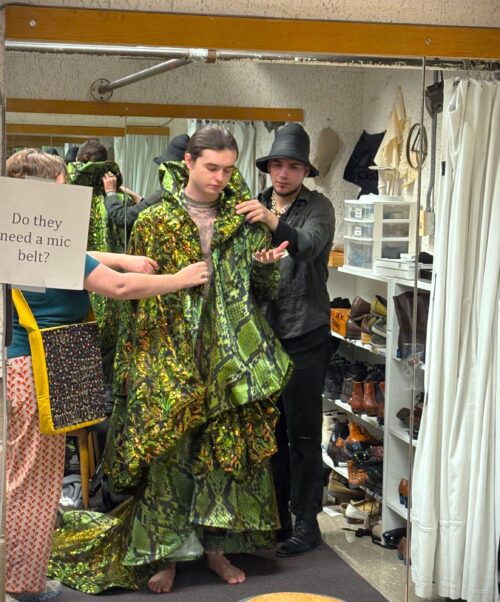
Design students concentrate on visual storytelling, dramaturgy and script analysis, deep research strategies, and leadership within the design process.
Technology students focuses on the engineering, chemistry, and management skills required to translate the conceptual language into 3D reality.
Both tracks:
- Share core coursework
- Train together in studios and production spaces
- Collaborate on all realized productions
- Access the same faculty and facilities
- Develop professional portfolios grounded in both thinking and making
Grounded in Tradition
We believe innovation requires mastery.
Our curriculum begins with sustained training in the classical foundations of costume practice:
- Costume history (two-semester sequence)
- Research in the psychology and sociology of dress
- Draping and flat patterning
- Tailoring and historical construction methods
- Textile research and material literacy
- Critical play analysis and dramaturgical research
Students also engage with museum and costume collections, Rare Books and Manuscript Library, visiting scholars, and professional practitioners to develop historical fluency and visual rigor.
Engaged with Innovation
Students are encouraged to test the boundaries of costume as a medium while remaining grounded in technique and scholarship.
Our program actively supports:
- Experimental and non-linear performance practices
- Digital costume rendering and 3-D visualization
- Clo3D technology
- Lazer cutting, 3D printing, LED and other lights in costumes, and sublimation printing
- Sustainable production practices
- Cross-disciplinary collaboration with art, engineering, and design
Strong Community
The program operates as a tight knit community within a larger ecosystem of the Krannert Center of the Performing Arts.
- 12 MFA students
- A strong BFA cohort
- Seven faculty specialists across design, technology, hair and makeup and drawing
- Professional costume shop staff
Students consistently cite the collaborative culture as one of the program’s defining strengths. The cohort functions as creative laboratory, professional network, and psychological support system.
Production as Pedagogy
Production assignments vary within the Krannert Center for the Performing Arts: the three resident producers, Theatre, Dance and Lyric, provide vast range of live production experiences.
Design students’ production assignments:
Minimum of two mainstage designs
One contemporary small/medium production
One large-scale opera or musical
In addition, there are opportunities to design with the Department Dance @ Illinois
Technology students’ production assignments:
One production assignment per semester
Roles include draper, crafts head, or equivalent
Assistantships & Professional Training
All admitted students receive assistantships that include:
Tuition waiver
Stipend
Professional experience in:
Krannert Center costume shop
Wig and makeup studio
Coordinating Costumes for the Department of Dance at Illinois
Costume rental
Thesis and/or Professional Internship
The Design MFA culminates in a substantial 2-semester independent thesis:
- A realized garment, production, or installation, supported by sustained research, experimentation, anddocumentation
The Costume Technology MFA culminates in the research-based project:
- Professional internship, conference presentation and/or museum reproduction
Facilities & Resources
Students work primarily within the Krannert Center for the Performing Arts, with access to:
- Fully equipped costume shop
- Millinery, Dye, Craft facilities
- Wig and makeup studio
- Siebel Center for Design with access to laser etching, 3D printing, large format printer, cnc routers.
- CU Community Fab Lab (3-D printing, laser cutting, electronics)
- School of Art & Design digital labs (screen printing, VR, digital fashion)
Career Outcomes
Graduates work as:
- Costume Designers
- Drapers and Crafts Artisans
- Costume Shop Managers
- Costume Faculty
- Wardrobe Supervisors
- Wig and Makeup Designers and creators
- Assistant Designers
- Art Administrators
- Fashion Industry Stylists
Recent production and class work by our students:
https://uofi.box.com/s/azy45v1mr9hrvoa4ixx53rmzx9e72wyi
Contact
For additional information:
Olga Maslova, Co-Chair of the Program, Head of Costume Design: maslova@illinois.edu
Meghan Pearson, Co-Chair of the Program, Head of Costume Technology: meghanlp@illinois.edu