
What to Expect-
The MFA in Costume Technology focuses on the engineering, chemistry, material science, and management skills required to translate conceptual design into 3D reality. Students develop advanced technical mastery through a combination of classical construction techniques, cutting-edge digital fabrication, and practical shop management.
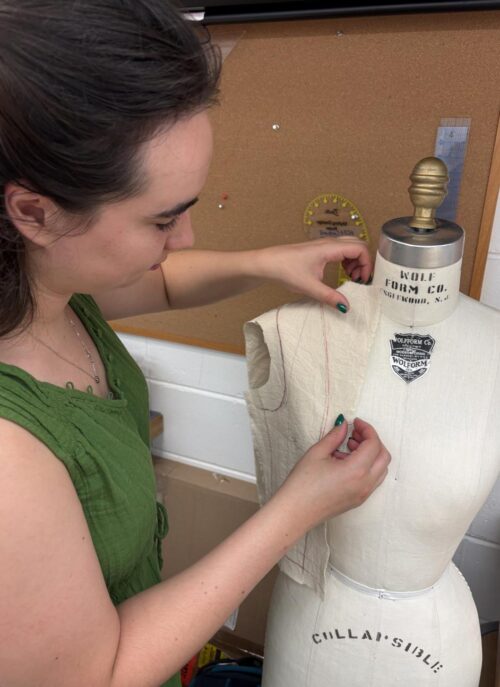
Core Pedagogy & Foundations
Classical Foundations
Innovation requires mastery. Costume Technology students undertake rigorous training in historical and classical construction practices:
- Patterning & Construction: Draping, flat patterning, tailoring, and historical construction methods.
- Textile & Material Science: Textile research, material literacy, dye, and craft techniques.
- Collection Access: Hands-on engagement with costume collections, museum archives, visiting scholars, and the Rare Books and Manuscript Library.
Technical Innovation & Digital Tools
Students are encouraged to test the boundaries of costume technology while staying grounded in craftsmanship:
- Digital Fabrication: Clo3D technology, digital rendering, 3D visualization, 3D printing, and laser cutting.
- Advanced Crafts & Lighting: LED and wearable technology integration, and sublimation printing.
- Sustainable Practices: Exploration of sustainable textile sourcing and eco-friendly shop production methods.
Production Experience & Pedagogy
Production assignments take place within the Krannert Center for the Performing Arts, working across three resident companies: Theatre, Dance, and Lyric Opera.
- Production Cadence: One major production assignment per semester.
- Key Leadership Roles: Cutter/Draper, Crafts Artisan / Crafts Head, First Hand, or equivalent technical leadership positions.
Financial Support & Assistantships
All admitted MFA Costume Technology students receive financial support packages, which include:
- Full Tuition Waiver
- Graduate Assistantship Stipend
Practical Shop Training
Assistantships provide hands-on experience in active professional environments, including:
- Krannert Center Costume Shop operations
- Wig, Hair, and Make-up Studio (WHAM)
- Costume Rental management
- Coordinating costumes for the Department of Dance at Illinois
Culminating Capstone / Thesis
The MFA in Costume Technology culminates in a practical, research-based project tailored to your career trajectory:
- Professional Internship with an industry shop, theater, or production house.
- Conference Presentation at national/international industry symposiums (e.g., USITT).
- Historical Museum Reproduction showcasing high-level technical research and reconstruction.
Dedicated Facilities & Resources
Costume Technology students work in world-class facilities at the Krannert Center for the Performing Arts and across the broader campus:
- In-House Shops: Fully equipped costume shop, dedicated dye and craft facilities, millinery studio, and wig/makeup studio.
- Siebel Center for Design: Access to laser etching, 3D printing, large-format printing, and CNC routers.
- CU Community Fab Lab: 3D printing, laser cutting, micro-electronics, and smart textiles.
- School of Art & Design Digital Labs: Screen printing, VR applications, and digital fashion technology.
Career Outcomes
Graduates of the Costume Technology program transition into key professional roles across theater, film, television, academia, and the fashion industry:
- Drapers & First Cutters
- Costume Crafts Artisans & Heads
- Costume Shop Directors & Technicians
- Wardrobe Supervisors
- Costume Technology Faculty
Cohort & Community
Our technology students operate within a tight-knit cohort supported by five specialized faculty across Costume technology, management, hair and makeup, and professional shop staff.
- Student Portfolio & Production Gallery: View Recent Student Work
Contact
For additional information:
Meghan Pearson, Chair of Costume Technology Program, MeghanLP@illinois.edu.