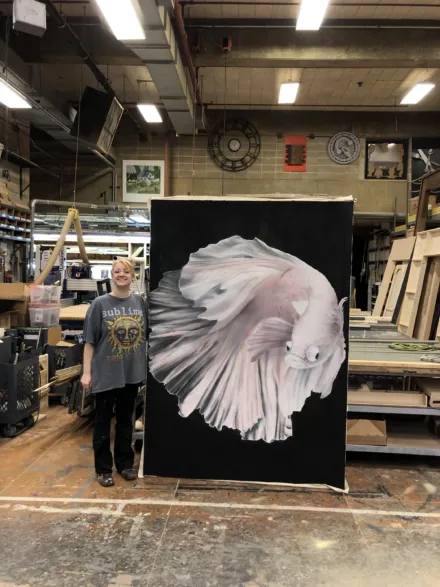
What to expect-
The Certificate in Scenic Art invites undergraduate students to learn the hands-on craft of scenic artistry through large-scale individual paintings and projects. Students will also learn the management side of scenic art by being the lead Scenic Charge Artist of a realized production, studying budgeting, collaboration, timelines and leadership.
Scenic artists are responsible for interpreting a designer’s scaled paint elevations and transforming them into the paint treatments executed for realized scenery. Every design is a new challenge: a sky backdrop, an oil painting, a marble floor, an abandoned train car, a sea cave. Scenic artists must understand art, story, light, chemistry, carving, surfaces, and physical environments to help fabricate the worldbuilding a design demands.
Scenic Artists work in theatre, film, television, museum installations, amusement parks, and immersive experiences. They can come from backgrounds in fine art, scenic design, theatre and entertainment, often working symbiotically to improve and fund their other areas of interest. This certificate prepares students to join a wide, marketable, and active career field which also enhances the storytelling and world-building of multiple entertainment industries.
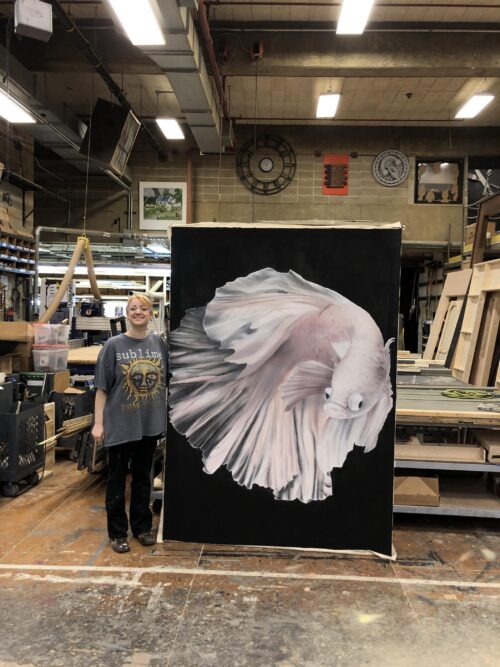

“I wouldn’t truly understand the value of my scenic art education until I started freelancing outside of Illinois Theater. I left with a wide foundation of painting techniques that I constantly return to. My classmates were also great sources of artistry and dedication, and having the opportunity to charge a team of my peers was the ultimate test of preparedness. Now, I see myself equipped not only with knowledge, but with confidence. In this industry, you never know what’s next, but a scenic’s superpower is the ability to figure it out. With this training, I believe anyone could be more than ready for that challenge.” -Blaine Fuson, a recent undergrad scenic design alumnus
Learning Outcomes
Students completing the Certificate in Scenic Art will be able to:
- Recreate the appearance of multiple natural surfaces with paint and textures.
- Successfully manipulate industry-standard tools, materials, and techniques, from bamboo and lining sticks to fabric manipulation, HVLP pneumatics and UV paints.
- Analyze a designer’s paint elevations to create full-scale paint treatments, interpreting the scaled art or images and then enhancing and enlarging it to full size.
- Develop a portfolio that showcases a progression of work, supporting application for professional or academic opportunities.
- Project manage a production, installation or event’s designed paint treatments, from budgeting and timeline through sampling, implementation, crew leadership and finish notes.

“I wouldn’t truly understand the value of my scenic art education until I started freelancing outside of Illinois Theater. I left with a wide foundation of painting techniques that I constantly return to. My classmates were also great sources of artistry and dedication, and having the opportunity to charge a team of my peers was the ultimate test of preparedness. Now, I see myself equipped not only with knowledge, but with confidence. In this industry, you never know what’s next, but a scenic’s superpower is the ability to figure it out. With this training, I believe anyone could be more than ready for that challenge.” -Blaine Fuson, a recent undergrad scenic design alumnus
Coursework
The certificate consists of four courses totaling 12 credit hours, designed to be completed over 4 semesters.
Purpose
The Certificate in Scenic Art introduces students to the skills, vocabulary, and practice of scenic art and management through Theatre and related FAA courses. Students will practice in studio labs, with tools and material exploration, and project management, building a foundation for further study, creative work, or professional opportunities in scenic art.
Coursework
Core Courses
- THEA 427: Scenic Painting I (3 credits) – Fall only, in-person
- THEA 428: Scenic Painting II (3 credits) – Spring only, in-person
- THEA 469: Scenic Painting III (3 credits) – Spring only, in-person
Experiential Learning
- THEA 400: Practicum, Scenic Charge Artist (3 credits) – Fall or Spring, in-person
OR
- THEA 490: Professional Internship (3 credits) – Fall, Spring, or Summer, off campus
Why Scenic Art?
Scenic artists are chameleons. Creating camera-ready faux finishes for film and television one day and painting soft watercolor skies the next, the work is always varied, challenging and fun. And with quality work everywhere from restaurants to film to theatre to theme parks, there is always work available for a talented and flexible scenic artist.
Application
Current undergraduate students at the University of Illinois Urbana-Champaign may initiate their certificate by completing this Certificate Initiation Form.
Non-degree students should review non-degree information here, then register with the university here and follow all non-degree enrollment instructions. Please initiate the certificate by submitting the Certificate Initiation Form once you have attended the first class of a certificate course.
Details
This certificate is credit-bearing, meaning that those who complete the course requirements will have a University of Illinois Urbana-Champaign transcript with the courses completed and grades. The certificate is non-transcriptable, meaning that you will not earn a degree or diploma and the certificate completion will not be listed on students’ transcripts.
Completion
Current undergraduate students at the University of Illinois Urbana-Champaign may indicate completion of their certificate by completing this Certificate Completion Form. Once the certificate coordinators verify completion of the certificate, it will be emailed to your netID. For official or unofficial transcripts reflecting the course completion, please request at https://registrar.illinois.edu/academic-records/transcripts/.
Questions
Please email Christina Rainwater at crainh2o@illinois.edu with any questions.